










































Vieques
Trip Ideas
Explore Further
Vieques stands squarely in the nexus of a cultural crossroads. Just 25 miles long and 5 miles wide, it is a rustic, slow-paced island where horses roam freely and going to the beach is just about the only thing to do, at least for now.
In 2003, the Pentagon conceded and the Navy withdrew from Vieques. Its land—15,000 acres on the east side, along with 3,100 acres on the west side that was ceded two years earlier—was handed over to the federal Fish and Wildlife Service, which has classified the property a National Wildlife Refuge. Much of the land is still off-limits while the Navy continues to clear it of contaminants and unexploded artillery, but so far two natural jewels, Red Beach and Blue Beach, on former Camp Garcia have been opened to visitors.
The east and west ends of the island are still mostly off-limits to civilians, and the island’s commercial districts are in the middle of the island. There are two communities, Isabel Segunda on the north coast and Esperanza on the south coast. Isabel Segunda is a small, traditional, but fairly charmless Puerto Rican town. Perhaps once the renovation of the plaza is completed, that will change. Many of the island’s services lie within its 20 or so blocks, including the only gas stations and ATM. This is also where the ferry docks, and the airport is nearby.
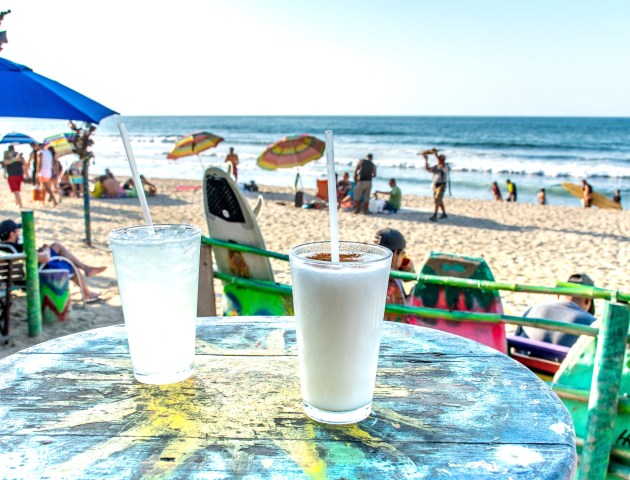
Esperanza is more geared toward tourism. It’s largely a residential area with a small strip of guesthouses and restaurants that line the coast overlooking the malécon, a picturesque sea walk rimmed by a balustrade. Two of the best reasons to visit Vieques are here: Sun Bay, one of the most beautiful public beaches in all of Puerto Rico, and Mosquito Bay, one of the world’s most spectacular bioluminescent lagoons. Esperanza is also home to quite a few U.S. expatriates, many of whom came for a visit and couldn’t bear to leave.
Aside from its gorgeous fine-sand beaches, coral reefs, and mangrove bays, inland Vieques is mostly thick hilly forest and arid, barren stretches of desertlike land. Bats are said to be the only animal native to Vieques, but other wildlife commonly found includes geckos, iguanas, frogs, deer, pelicans, seagulls, egrets, herons, doves, and, of course, horses. Horses are a common mode of transportation in Vieques, and they follow the same traffic laws as automobiles, stopping at four-way stops, and so on. But they also graze and roam freely. The waters around the island are home to several endangered animals, including the manatee and sea turtles.
Accommodations on Vieques tend to be either small luxurious inns or bare-bones guesthouses. Few rooms have TVs or telephones—even the high-end ones. Several interesting restaurants serving international and Caribbean cuisine have opened in recent years. Nearly every business accepts credit cards, unless otherwise noted, and it’s a good thing: Vieques is not inexpensive. Because nearly every commodity must be shipped in, prices for everything from accommodations to meals rival those in San Juan. Many businesses close on Mondays and during the low-season summer months. Even during the high season, posted business hours may be more of a suggestion than reality. It’s always a good idea to call first.
There are occasional water shortages on the island, and plumbing can be a bit of an issue. Signs in public restrooms request that toilet paper be discarded in wastepaper baskets instead of flushed. There are also occasional gasoline shortages, especially on weekends.
Vieques is home to 10,000 inhabitants, and it reportedly has one of the highest unemployment rates in the United States. It’s not surprising that petty theft from parked cars is a continuing problem. When in town, visitors are encouraged to keep their cars locked at all times and never to leave anything in them. The greatest threat to car break-ins is at the beach, where culprits use a smash-and-grab tactic. Drivers are encouraged to leave all the windows rolled down and the sunroof and glove box open to avoid having to pay the cost of replacing a broken window. And always park your car as close to you as possible—preferably away from any bushes and within sight range.
Except for a couple of late-night watering holes, there’s little nightlife in Vieques. Since most accommodations don’t have TVs and the restaurants typically close by 10 p.m., the best option is just to go to bed so you can hit the beaches early the next day.
With the Navy gone, Vieques is teetering on the cusp of a new era. If you want to see it in its pristine glory, you’d better go soon.
Getting to Vieques
The Puerto Rico Port Authority (in Vieques 787/741-4761, 787/863-0705, or 800/981-2005, daily 8–11 a.m. and 1–3 p.m.) operates a daily ferry service between Vieques and Fajardo.
The passenger ferry is primarily a commuter operation, and it can often be crowded—especially on the weekends and holidays when vacationers swell the number of passengers. Reservations are not accepted, but you can buy tickets in advance. Arrive no later than one hour before departure. Sometimes the ferry cannot accommodate everyone who wants to ride. The trip typically takes about an hour to travel between Fajardo and Vieques, and the fare is $4 round-trip per person. Note that ferry schedules can change, but the schedule was as follows:
- Fajardo to Vieques: Monday–Friday 9:30 a.m., 1 p.m., 4:30 p.m., 8 p.m.; Saturday–Sunday and Monday holidays 9 a.m., 3 p.m., 6 p.m.
- Vieques to Fajardo: Monday–Friday 6:30 a.m., 11 a.m., 3 p.m., 6 p.m.; Saturday–Sunday and Monday holidays 6:30 a.m., 1 p.m., 4:30 p.m.
There is also a weekday cargo/car ferry, for which reservations are required. But be aware that most car-rental agencies in Puerto Rico do not permit their automobiles to leave the main island. The best option is to leave your car in Fajardo and rent another car on Vieques. The trip usually takes about two hours, and the cost is $15 for small vehicles and $19 for large vehicles. The schedule is as follows:
- Fajardo to Vieques: Monday–Friday 4 a.m., 9:30 a.m., 4:30 p.m.
- Vieques to Fajardo: Monday 6 a.m., 1:30 p.m., 6 p.m.
As almost anyone who’s taken the commuter ferry from Fajardo to Vieques will tell you, the best way to get to the island is by air. There are several small airlines that fly to Vieques from the main island, and the flights are fairly inexpensive and speedy.
In San Juan, flights can be arranged from Luis Muñoz Marín International Airport near Isla Verde or from the smaller Isla Grande Airport near Old San Juan. But the shortest, cheapest flight is from the newly opened Jose Aponte de la Torre Airport on the former Roosevelt Roads Naval Base in Ceiba on the east coast. Round-trip flights are about $190 from San Juan and $60 from Ceiba. Flights between Vieques and Culebra are about $70.
Service providers include Isla Nena Air Service (787/863-4447, 787/863-4449, or 877/812-5144, islanenapr [at] centennialpr [dot] net, www.islanena.8m.com); Vieques Air Link (787/741-8331 or 888/901-9247, valair [at] coqui [dot] net, www.viequesairlink.com); M&N Aviation (787/791-7008, www.mnaviation.com); and Air Flamenco (787/724-1818, airflamenco [at] hotmail [dot] com, www.airflamenco.net).
© Suzanne Van Atten from Moon Puerto Rico, 2nd Edition
Buy Moon Travel Guides
Search
Moon Travel Guides make independent travel and outdoor exploration fun and accessible. With expert and adventurous travel writers delivering a mix of honest insight, first-rate strategic travel advice, insider travel tips and an essential dose of humor, Moon Travel Guides ensure that travelers have an uncommon and entirely satisfying experience. Each travel book is filled with unique trip ideas, easy-to-use maps, and detailed information on sights, restaurants, and accommodations. Moon Travel Guides not only point you in the right direction, they inspire new ideas and adventure. Whether you are seeking a relaxing beach trip to Hawaii, or an adventure travel trip to the rainforests of Costa Rica, Moon guidebooks—and Moon.com—are with you every step of the way. Founded in 1973, the Moon Travel Guides series includes Moon Handbooks, Moon Outdoors, Moon Metro, Moon Living Abroad and Moon Spotlight travel books. Moon is based in Berkeley, California and is a proud member of the Perseus Books Group.