



















Brazil Blog
About this blog
Thrill of Brazil is a travel blog all about Brazil written by Moon Brazil author Michael Sommers. Michael blogs about Brazil travel, culture, and more. He welcomes questions, comments, and story ideas.
Recent Posts
- Care for a Drink with your Film? (or a Film with your Drink?)
- Brazil’s Homegrown Tourism Boom
- Brazil's Best and Write-est
- Making House Calls in Rio (Part II)
- Making House Calls in Rio (Part I)
- The Dawning of Brazil's B&B Age
- Rio's Alternative Points of View
- Taxi Trouble in Santa Teresa
- Obamas Take to the Campaign Trail in Brazil
- Plans and Punctuality
- Reliving Tropicalismo - On and Off Screen
- Food and Lodging that Make the Grade
- The Making of Moon Living Abroad in Brazil
- U.S. is Number One Source of Immigrants to Brazil
- Best English-Language Blogs about Brazil

Bye Bye to Salvador's Beach Barracas
Brazil has famously been called a “crab culture” due to the fact that roughly 70 percent of the population lives along the country’s sprawling 7,400km of coastline. It follows that, for many Brazilians, the country’s endless (and often very beautiful) beaches are a major source of livelihood and leisure, and are intricately tied to a quintessential Brazilian lifestyle.
Like those of many coastal cities, Salvador's beaches – whose 70 kilometers of urban coastline range from small coves, lapped by the placid, lake-like waters of the Bay of All Saints , to the open Atlantic waters of the non-stop “orla” that runs from Barra to Stella Maris – are an integral part of the city’s identity.
Completely democratic territories, Salvador's beaches are playgrounds where rich and poor alike can escape the tropical heat and stress of daily life, and work out, flake out, make out, and/or just hang out. And to help Soteropolitanos (residents of Salvador) better while away a few hours in the sand, God invented the beach barraca.
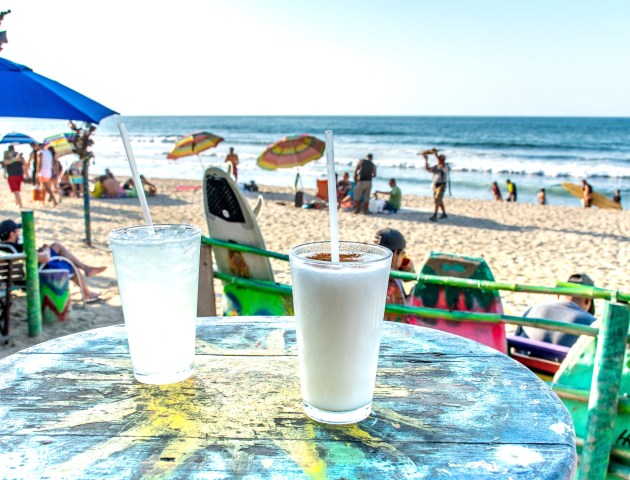
Throughout Brazil, but especially in the Northeast, beach-going would be unimaginable without barracas. These seaside restaurant/bars are where friends and family settle in for a long day of chatting, drinking beer, and nibbling on portions of fried fish and seafood, punctuated by the occasional foray into the ocean to cool off (although, truth be told, many barraca devotees actually never set foot in the water).
The classic barraca is no more than a rudimentary shelter made from tree trunks and palm thatch. Over the years, however, this basic concept has evolved. Depending on the location and the clientele, today’s barracas come in all styles and sizes. Fashioned out of cement, glass, and polished wood, super-barracas resembling private clubhouses come tricked out with amenities such as bathroom and shower facilities, personal lockers, Wi-Fi, kiddie playgrounds, and DJ stations. Most barracas, however, still hew to the basic formula of a shack presiding over a micro empire of plastic tables, chairs, and big parasols for shade.
In Salvador, the subject of barracas has been on the lips of everyone and their mother – not to mention President Lula who was in town this week – due to the fact that, on Monday, the municipal government (on orders from the federal government) dispatched crews to raze all of Salvador’s remaining 349 barracas to the ground.
In true Brazilian fashion, the story behind the decimation of these barracas (in total, there were over 500) is a complicated and convoluted one. But to sum up (and vastly oversimplify) the situation, in Brazil, all beaches belong to the federal government (i.e. there’s no such thing as a private beach). Hence, all barracas that have been erected on the sands of Salvador’s beaches constitute illegal “invasions” of public property.
The problem is that, for decades, the federal government (and IBAMA – the government’s environmental agency and watchdog) ignored the influx of barracas as did subsequent municipal governments. Years went by and, unchecked, Salvador’s barracas proliferated until, in 2007, a federal judge ruled that enough was enough: aside from illegal, the mushrooming of barracas had “transformed the once beautiful city beaches into the most horrendous and bizarre stretch of coastline of any of the Brazilian capitals” (!)
In his ruling, the judge also soundly scolded the municipal government for its lax attitude. But in fact, the current mayor was the one responsible for bringing attention to the barracas’ irregularity in the first place. In 2006, he accepted bids for the construction of mega-barracas, which so flagrantly flouted IBAMA standards that they were destroyed prior to completion. Once the federal government became aware that all of Salvador’s barracas were illegal, their days were numbered. The mayor spent the next three years trying to stay the hands of justice (with scant thought as to what would happen if he didn’t succeed). His efforts, however, were in vain; earlier this year, the first phase of bulldozing began.
In Salvador, people are very split about the destruction of the barracas. Many agree that their encroachment had led to a “favela-ization” of the beaches, which had become increasingly dirty (hygiene is not always up to par), not to mention noisy (many use their blaring sound systems to drown out those of their neighbors). On the other hand, it was impossible not to feel outrage and empathy for the thousands of poor, hard-working families who, in a matter of minutes, saw their livelihoods become reduced to rubble without any solutions or succor from the government.
Indeed, later this week, after Lula publicly lambasted the city for its abandonment of the barraqueiros, the municipal government suddenly burst into action, launching the idea of a special temporary “barraca kit”. Consisting of a canvas awning and two coolers for cold drinks, along with a dozen beach chairs and umbrellas that can be rented out to customers, this “kit” will allow a select number of former barraqueiros to operate “portable” barracas at given locations. Although the makeshift plan has yet to be approved, this is what summer on Salvador’s beaches promises to look like.
In the meantime, the beaches appear terribly empty, and suddenly much bigger – for the first time in a long time, one can actually see them!
Buy Moon Travel Guides
Search
Moon Travel Guides make independent travel and outdoor exploration fun and accessible. With expert and adventurous travel writers delivering a mix of honest insight, first-rate strategic travel advice, insider travel tips and an essential dose of humor, Moon Travel Guides ensure that travelers have an uncommon and entirely satisfying experience. Each travel book is filled with unique trip ideas, easy-to-use maps, and detailed information on sights, restaurants, and accommodations. Moon Travel Guides not only point you in the right direction, they inspire new ideas and adventure. Whether you are seeking a relaxing beach trip to Hawaii, or an adventure travel trip to the rainforests of Costa Rica, Moon guidebooks—and Moon.com—are with you every step of the way. Founded in 1973, the Moon Travel Guides series includes Moon Handbooks, Moon Outdoors, Moon Metro, Moon Living Abroad and Moon Spotlight travel books. Moon is based in Berkeley, California and is a proud member of the Perseus Books Group.